How to Choose EDC Software for a Clinical Trial?
Choosing EDC or an eCRF software for a clinical trial involves more than simply replacing paper forms with electronic forms.
The software can affect study setup timelines, data entry by investigators, clinical data quality, monitoring, and ultimately statistical analysis.
Requirements can vary significantly from one clinical trial to another. A single-center retrospective study involving one hundred patients does not have the same requirements as an international prospective study or a multicenter registry following several thousand patients over multiple years.
So, what criteria should you consider when choosing
EDC/eCRF software for a clinical trial?
What Is EDC/eCRF Software?
An eCRF (electronic Case Report Form) is an electronic form used to collect the clinical data defined by the protocol for each participant in a clinical trial. It translates the protocol into structured forms and variables.
An EDC (Electronic Data Capture) system refers more broadly to the software used to collect and manage clinical trial data. The eCRF is generally one component of an EDC system.
This article focuses on the next practical question:
how do you choose the right EDC/eCRF software for your clinical trial?
Start With the Requirements of the Clinical Trial
The choice of software should start with the clinical trial, not with the vendor's feature list.
Study design, the number of patients and sites, countries involved, follow-up duration, data and endpoints to be collected, potential Patient-Reported Outcomes, monitoring requirements, integrations, and planned statistical analyses can all influence the choice of EDC/eCRF software.
A retrospective single-center study does not have the same requirements as an international prospective clinical trial or a registry following patients over several years.
The objective is not to choose the software with
the largest number of features, but the one that best meets the clinical, operational, and regulatory requirements of the study.
1. How Quickly Can the eCRF Be Configured and Deployed?
The first consideration is the ability to translate the clinical trial protocol into an operational eCRF.
An EDC platform should support the configuration of the required forms, visits and variables, together with conditional logic, validation rules, consistency checks and instructions for investigators. The eCRF should also be tested before the study is launched.
The configuration model can have a significant impact on deployment. Some platforms allow clinical teams to configure or modify much of the eCRF directly, while others require greater involvement from the software provider or additional technical development.
Study amendments should also be considered. When the protocol changes, the EDC should provide an appropriate process for modifying the eCRF while maintaining the integrity and interpretability of data already collected.
For organizations conducting multiple clinical trials, reusability can become another selection criterion. Reusing validated variables, forms, questionnaires or study structures can reduce configuration time and improve standardization across studies. Any reused component should nevertheless be reviewed against the protocol and objectives of the new study.
When comparing platforms, consider the complete timeline from finalized protocol to a tested eCRF ready for investigator use, as well as the resources required from the clinical team during this process.
For medical device manufacturers conducting PMCF studies, these principles are covered in more detail in
PMCF Clinical Trials: How to Design an Effective eCRF.
2. Can the Software Support Clinical Data Quality?
Clinical data quality should be addressed during data collection rather than relying exclusively on data cleaning at the end of the study.
Depending on the protocol, an EDC/eCRF system may need to support required fields, predefined response options, validation ranges, date controls, conditional logic and consistency checks between variables or visits.
For example, a consistency check may identify a follow-up date occurring before the inclusion date or flag two clinical variables containing logically incompatible information.
Missing data also need to remain interpretable. An empty field may indicate that information was forgotten, unavailable, unknown or not applicable. When this distinction is relevant to the study, the EDC should allow these situations to be managed appropriately and enable study teams to identify incomplete forms or visits.
Conditional logic can further improve data collection by displaying questions only when they are relevant to a particular patient or situation.
The objective is not to maximize the number of automated controls. The EDC should support
the validation and consistency rules that are clinically and methodologically relevant to the clinical trial.
3. Is the eCRF Easy for Investigators to Use?
Clinical data quality also depends on the experience of the people entering the data.
Investigators and study coordinators may use the EDC alongside routine clinical activities. Unnecessary complexity can increase data-entry time, training requirements and operational workload.
Navigation between patients, visits and forms should therefore be clear. Questions and instructions should be understandable, and conditional logic should limit the display of irrelevant fields when appropriate.
For international studies, multilingual capabilities may also be required. The interface should be compatible with the devices and environments in which investigators are expected to enter data.
Training requirements are another consideration, particularly in multicenter studies involving a large number of users or regular changes in study personnel.
Software demonstrations should therefore include
the complete investigator workflow for a patient visit, rather than focusing exclusively on sponsor or administrator functionality.
4. Can the Software Support Multicenter Studies, Monitoring and Queries?
Multicenter clinical trials require appropriate management of both clinical sites and users.
Investigators, study coordinators, monitors, data managers and sponsor teams may require different levels of access. Role-based permissions should allow users to access the data and functionality required for their responsibilities while restricting unnecessary access.
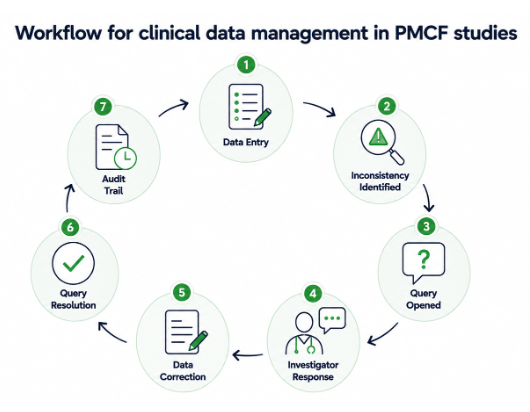
Once clinical data have been entered, they may need to be reviewed, queried, corrected and monitored. The EDC should support workflows for identifying incomplete or potentially inconsistent data, creating and resolving queries, monitoring study progress and documenting relevant corrections.
The audit trail is an important part of this process. When clinical data are modified, the system should provide appropriate traceability of the change, including what was changed, when the modification occurred and who performed it.
These capabilities are best evaluated as part of a complete workflow:
5. Does the Clinical Trial Require ePRO?
Some clinical trials require data to be reported directly by patients rather than entered by investigators.
These data may include symptoms, pain, quality of life, satisfaction, functional outcomes or other Patient-Reported Outcomes (PROs).
An ePRO (electronic Patient-Reported Outcome) system allows patients to complete these assessments electronically, with the resulting data incorporated into the clinical data workflow.
For longitudinal clinical trials, ePRO can be particularly useful for collecting patient-reported data over time. Depending on the protocol, the system may need to support scheduled or recurring questionnaires, automated reminders, multilingual forms, mobile access and automatic scoring.
When ePRO and eCRF are used within the same study, the relationship between the two data sources should also be considered. Direct integration can reduce manual data transfer and avoid the creation of separate clinical databases.
Not every clinical trial requires ePRO. Its use should be determined by the endpoints and data collection methods defined in the protocol.
For a detailed introduction, see
What Is an ePRO? Electronic Patient-Reported Outcomes in Clinical Trials.
6. Can the Software Support Long-Term Studies, Clinical Registries and Multiple Projects?
Some clinical trials and registries involve data collection over several years.
During a long-term study, clinical sites may join or leave, investigators may change, additional patients may be enrolled and study amendments may become necessary.
An EDC platform intended for this type of study should therefore be evaluated not only on its initial configuration but also on its ability to support the study over time while preserving previously collected data.
Version management, longitudinal patient follow-up, historical data access, management of changing users and sites, database scalability and long-term export capabilities may all become relevant.
The same consideration applies across multiple studies. Organizations conducting several clinical trials may benefit from standardizing certain variables, forms or questionnaires and reusing validated components when appropriate.
For organizations conducting multiple clinical trials, EDC selection should therefore consider
standardization and reuse across the clinical study portfolio, rather than focusing exclusively on the requirements of a single study.
7. How Are Data Export, Statistical Analysis and Integrations Managed?
EDC/eCRF software should be evaluated with the complete clinical data lifecycle in mind.
The database ultimately needs to support the statistical analyses defined for the study. Before selecting a platform, consider how variables, labels, categorical values, missing data, repeated measurements and metadata will be represented in exported datasets.
Study teams should also determine whether they can generate exports independently and whether the available formats are compatible with their statistical workflow.
Some EDC platforms provide integrated statistical capabilities, while others focus on producing structured datasets for analysis in external statistical software. The appropriate approach depends on the study and the organization.
The key requirement is that the data structure and export workflow support the analyses planned in the protocol.
External integrations should be assessed in the same way. Depending on the clinical trial, clinical data may need to be imported from hospital information systems, EHR/EMR systems, medical devices, imaging systems, laboratories, registries or other clinical databases.
When external data are required, the assessment should cover available APIs or import mechanisms, data mapping, validation of transferred data, error management and traceability.
If an integration is essential to the clinical trial,
its technical feasibility should be assessed before the EDC platform is selected.
8. Does the Platform Support the Security and Regulatory Requirements of the Clinical Trial?
Clinical trials may involve personal and health data. Security and data protection should therefore form part of the EDC assessment.
Depending on the study and applicable requirements, relevant considerations may include data hosting and location, encryption, authentication, role-based access, backups, business continuity, data retention, traceability and privacy requirements.
For European studies, the General Data Protection Regulation (GDPR) may also apply to the processing of personal data.
Regulatory requirements should be assessed according to the specific clinical trial rather than through a generic list of regulations or certifications.
Depending on the context, relevant EDC functionality and documentation may include audit trails, controlled access, authentication, electronic signatures where required, data traceability, software validation documentation and appropriate data retention and export capabilities.
For medical device manufacturers conducting PMCF studies in the European Union, additional requirements under Regulation (EU) 2017/745 may also need to be considered.
The assessment should therefore go beyond asking whether an EDC is simply “compliant.” The relevant question is whether
the functionality and documentation provided by the software support the requirements applicable to the specific clinical trial.
9. What Are the Total Cost and Level of Support?
The software license does not necessarily represent the total cost of using an EDC/eCRF system.
Depending on the pricing model, costs may also arise from study configuration, eCRF setup, users, clinical sites, patients, ePRO, training, support, integrations, study amendments, data management, monitoring, statistical analysis or study extensions.
This can be particularly important for long-term studies, clinical registries and organizations conducting several clinical trials. A pricing model suitable for a short study may have different financial implications when applied over several years or across multiple projects.
Cost comparisons should therefore be based on the expected total cost over the study lifecycle, using comparable study assumptions.
The level of support should be assessed alongside cost. Relevant considerations include responsibility for study configuration, user training, management of amendments, technical support, assistance with integrations, and support during database export and study closure.
A lower initial software price does not necessarily result in a lower total cost if additional internal resources or external services are required throughout the study.
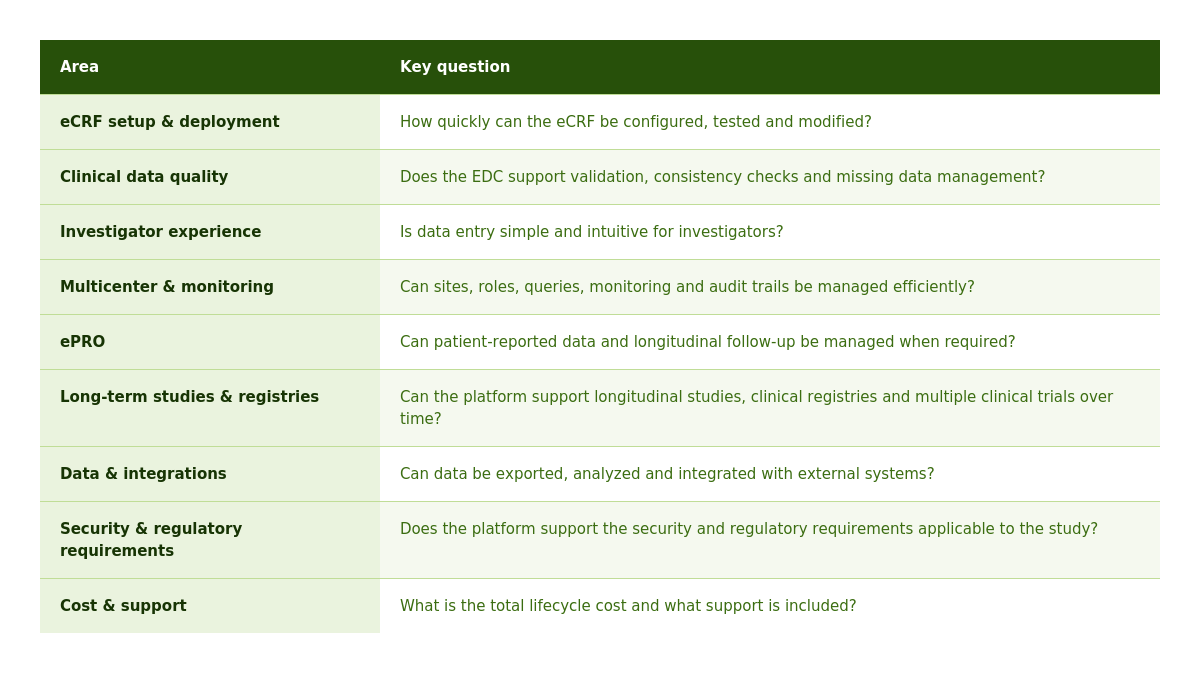
EDC/eCRF Software Checklist for a Clinical Trial
Once the clinical, operational and regulatory requirements have been defined, the same criteria can be applied to each shortlisted platform.
What Should Be Evaluated During an EDC/eCRF Software Demo?
A generic demonstration provides limited information about how an EDC platform will perform in a specific clinical trial.
A more useful assessment is based on the same study scenario for each shortlisted platform.
The demonstration can include the configuration of part of the actual eCRF and a relevant consistency check, followed by a complete investigator visit. The monitoring workflow can then be assessed by introducing an inconsistency, creating a query, correcting the data and reviewing the resulting audit trail.
When relevant to the protocol, the same demonstration can cover patient ePRO collection, study amendments, multicenter management, external integrations and database export for statistical analysis.
Deployment time, resources required from the study team, support and total cost should then be compared using the same assumptions.
This approach provides a more meaningful comparison than evaluating platforms solely on their feature lists.
How to Choose the Right EDC/eCRF Software for a Clinical Trial
The appropriate EDC/eCRF software for a clinical trial is not necessarily the platform with the largest number of features.
It is the platform that supports the study design, required clinical data, investigator workflow, monitoring strategy, statistical analyses, regulatory requirements, timeline and budget.
The EDC/eCRF selection process can be summarized as follows:
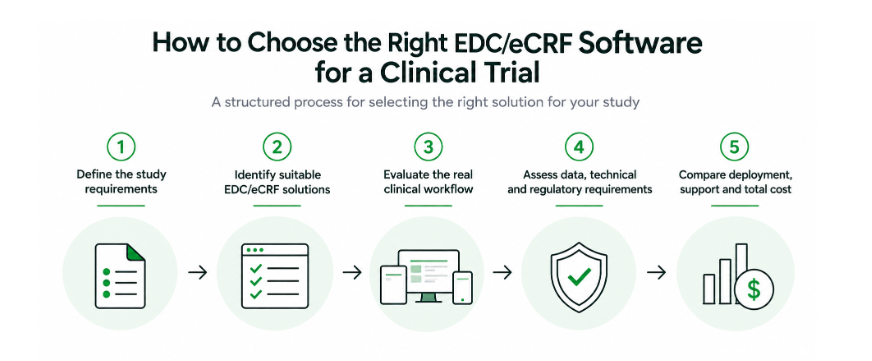
For organizations conducting multiple clinical trials, the assessment can also consider the ability to standardize and reuse appropriate components across future studies and clinical registries.


Share this article