What Is an ePRO (Electronic Patient-Reported Outcome)?
An ePRO (Electronic Patient-Reported Outcome) enables the electronic collection of health information reported directly by patients, without interpretation by a healthcare professional or other third party.
In clinical trials, ePROs are used to capture patient-reported data on symptoms, functioning, and the patient’s experience of a disease or treatment.
These data are typically collected through ePRO questionnaires or electronic patient diaries (eDiaries) that patients can access from a smartphone, tablet, or web-based interface.
What Is the Role of ePRO in Clinical Trials?
ePRO brings the patient perspective directly into clinical study assessments. It complements investigator-reported data by capturing information that patients are best placed to report themselves, including their symptoms, functioning, and the impact of a disease or treatment on their daily lives.
Electronic data collection also enables this information to be captured at different time points throughout the study, including between site visits. Research teams can therefore track changes over time without the need for intermediate transcription or manual data entry.
Depending on the study objectives,
ePRO data may be used to support clinical endpoints or to assess treatment efficacy, tolerability, and overall impact from the patient’s perspective.
What Data Can Be Collected Through an ePRO Questionnaire?
An ePRO solution can capture a wide range of patient-reported data on health status and treatment experience during a clinical study.
This may include
symptoms such as pain, fatigue, or nausea;
quality of life;
physical and functional status;
physical or psychological well-being; and the patient’s perception and experience of treatment. Data can be collected at specific time points using standardized
patient questionnaires or repeatedly over time through electronic patient diaries.
What Is the Difference Between ePRO and eCRF?
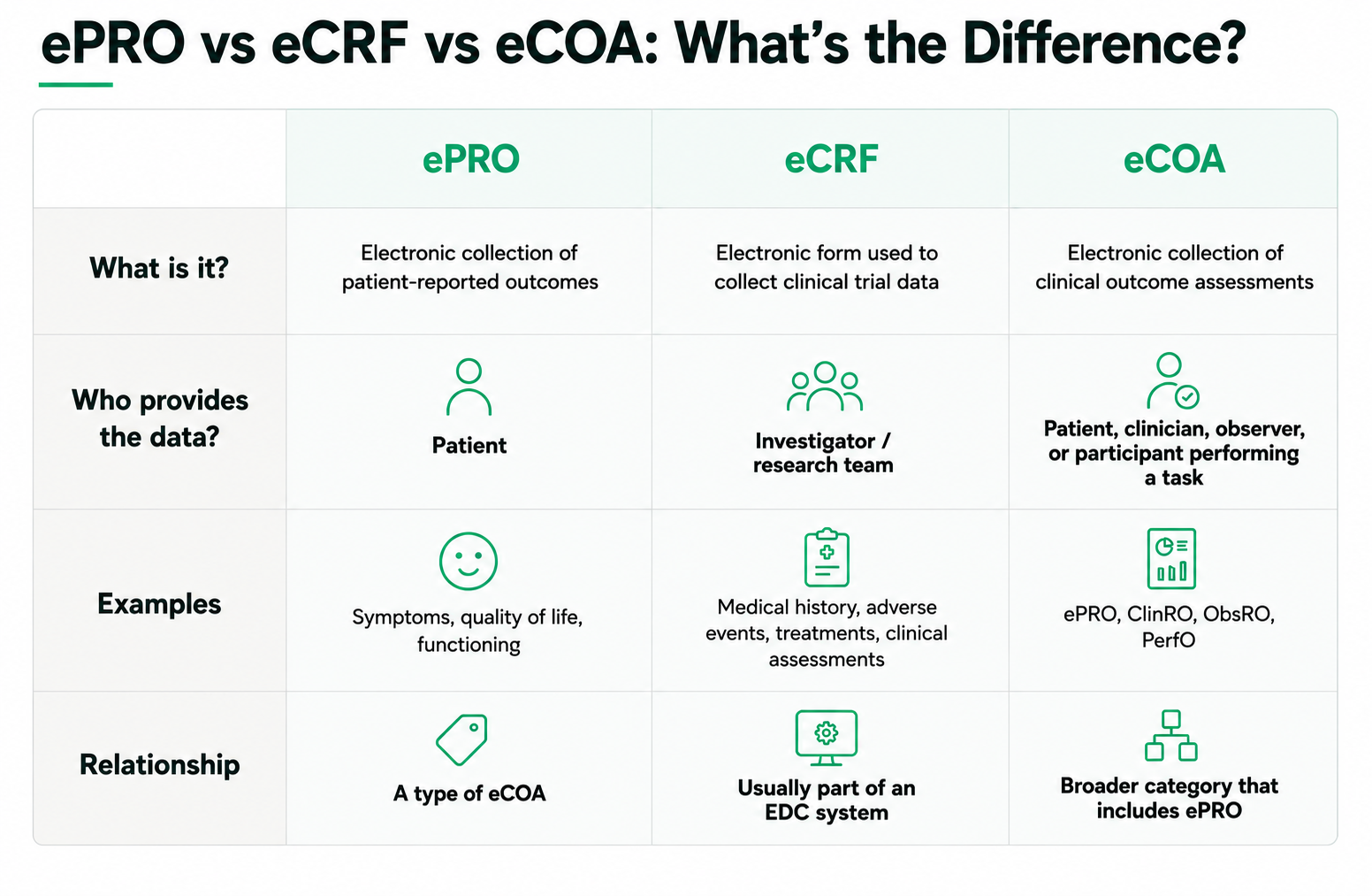
eCRF (Electronic Case Report Form) and ePRO (Electronic Patient-Reported Outcome) are often used within the same clinical trial, but they serve different purposes.
- An eCRF is an electronic form used by investigators and research teams to capture protocol-defined study data, such as clinical observations, assessments, treatments, and adverse events.
- An ePRO, by contrast, captures data directly from patients, without interpretation by a healthcare professional. It can be used to document patient-reported symptoms, functioning, and aspects of quality of life.
This distinction is important because information such as pain intensity, fatigue, or the impact of treatment on daily life is best reported directly by the patient.
In practice,
eCRF and ePRO capabilities can be integrated within the same
EDC (Electronic Data Capture) platform. Investigator-entered data and patient-reported data can therefore be centralized in a single, secure environment.
What Is the Difference Between ePRO and eCOA?
eCOA (Electronic Clinical Outcome Assessment) refers to the electronic collection of clinical outcome assessments (COAs) during a clinical trial. It is a broad category that includes different types of assessments based on how and by whom the information is reported or measured.
ePRO (Electronic Patient-Reported Outcome) is a type of eCOA in which data are reported directly by the patient, without interpretation by a healthcare professional or other third party.
eCOAs can also include assessments reported by a trained healthcare professional (ClinRO), by an observer such as a parent or caregiver (ObsRO), or based on a standardized task performed by the patient (PerfO).
In short,
ePRO is a category of eCOA specifically designed to capture outcomes reported directly by patients.
How Does ePRO Software Work?
ePRO software typically follows a data collection schedule defined by the study protocol.
Patients are invited to complete
ePRO questionnaires at predefined time points, either during study visits or at regular intervals between visits, using a smartphone, tablet, or web-based interface. Their responses are then automatically captured in the study database.
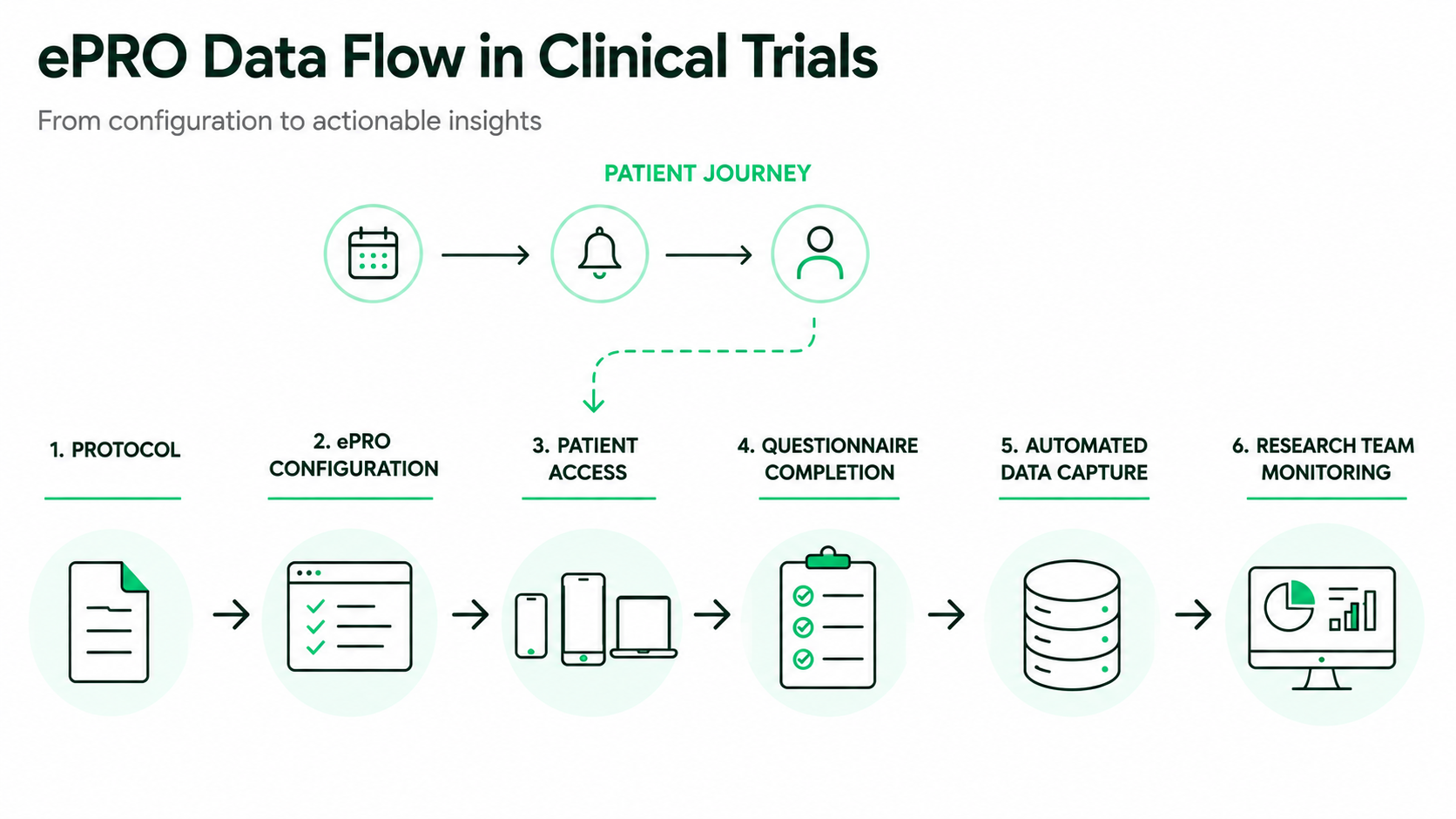
Automated reminders can be scheduled to encourage patients to complete required questionnaires and help reduce missing data. Research teams can monitor completion rates, identify missing assessments, and follow up with patients when needed.
When
ePRO software
incorporates a validated questionnaire or instrument, such as the
EQ-5D, its electronic implementation must comply with the requirements applicable to that instrument, including its content, response options, and scoring rules.
What Are the Regulatory Requirements for ePRO?
The use of an ePRO solution in clinical research falls within the regulatory framework governing computerized systems used to collect clinical data. The solution must support the integrity, traceability, confidentiality, and security of patient data throughout the study.
In clinical trials, ePRO systems must meet the requirements applicable to computerized systems and electronic data under Good Clinical Practice (ICH-GCP). Data and any changes made to them must be traceable, original data must be preserved, and access must be appropriately controlled. Systems should also be fit for their intended purpose and subject to appropriate validation processes.
For medical devices, an ePRO solution may be used in clinical investigations or as part of post-market clinical follow-up (PMCF). These activities fall within the framework of the EU Medical Device Regulation (EU) 2017/745 (MDR) and, for clinical investigations, ISO 14155. Patient-reported data collected through ePRO can contribute to the clinical evaluation of a medical device throughout its lifecycle.
In Europe, personal data collected through an ePRO solution are also subject to the General Data Protection Regulation (GDPR). In France, health research must comply with applicable CNIL requirements and, where their conditions are met, the relevant reference methodologies, including MR-001 and MR-003. Where French health data hosting requirements apply, data hosting must also comply with applicable HDS certification requirements.
For studies subject to
FDA requirements, electronic systems may also need to comply with
21 CFR Part 11 requirements for electronic records and electronic signatures, where applicable.
What Are the Key Features of ePRO Software?
- Multilingual and multi-device access: An ePRO solution should enable patients to complete questionnaires in their preferred language using a smartphone, tablet, or computer. Web-based solutions can also reduce the need to install and manage a dedicated application.
- Support for validated questionnaires: An ePRO solution should support validated questionnaires and scales while preserving their structure, response options, and, where applicable, scoring rules.
- Automated scheduling and reminders: Questionnaires can be scheduled according to the study protocol, with automated notifications and reminders when an assessment is due.
- Real-time completion tracking: Research teams can monitor questionnaire completion, identify missing assessments, and follow up when needed, rather than discovering missing data during a monitoring visit.
- Integration with EDC and eCRF: Patient-reported data can be centralized within the same environment as data collected through the eCRF. This integration reduces manual data entry and enables research teams to work from a common study database.
- A patient-friendly interface: The user experience should accommodate the diverse populations participating in clinical research.
Simple navigation, a clear interface, and intuitive workflows make ePRO software easier to use, particularly for patients who may be less familiar with digital tools.
What Are the Key Benefits of ePRO?
Direct measurement of the patient experience: ePRO captures information directly from patients without intermediate interpretation, bringing into the study outcomes that patients are best placed to assess themselves.
More consistent data collection over time: Data can be collected at multiple time points throughout the study, including between site visits, providing a more continuous view of changes in symptoms, functioning, and quality of life.
Improved data quality: Direct patient entry eliminates intermediate transcription steps, while automated scheduling and reminders help reduce missed or late questionnaire completion.
Reduced operational burden:
Automating questionnaire distribution, reminders, and completion tracking
reduces manual tasks for research teams.
How to Choose ePRO Software for Clinical Trials
Beyond individual features, choosing the right ePRO software requires considering how well the solution can meet the specific requirements of the study while supporting efficient deployment and an intuitive experience for both patients and research teams.
- Ease of deployment: ePRO software should adapt quickly to the study protocol, questionnaires, and data collection schedule without requiring custom development.
- Platform flexibility: An ePRO solution should be able to evolve with the study. Questionnaires, collection schedules, and associated rules should be easy to add or modify while maintaining applicable validation requirements.
- Patient experience: Device availability alone is not enough. The number of steps required to access a questionnaire, interface readability, and overall ease of use can directly affect the quality and completeness of data collection.
- Compliance and security: The solution should meet study requirements for data protection, integrity, and traceability. The provider should also be able to document the compliance and validation of its platform.
- Implementation and support: The provider’s ability to support configuration, deployment, questionnaire management, and research teams throughout the study is particularly important for
multicenter or international studies.
What Are the Main Challenges of Using ePRO?
ePRO can present several challenges, particularly when data collection extends over long periods. Questionnaires that are too frequent or complex, an unintuitive interface, or limited familiarity with digital tools can affect completion rates and increase the risk of missing data.
To maintain patient engagement,
questionnaires should be kept as simple as the protocol allows and scheduled at intervals appropriate for the study population.
Automated reminders,
completion tracking, and an interface accessible across devices can
help research teams identify missing assessments early and follow up when needed.
Simplify Patient Data Collection with ePRO
With EasyMedStat, integrate ePRO directly into your clinical studies and centralize patient-reported data on a single platform.
Discover how EasyMedStat can simplify patient data collection and monitoring.


Share this article