What Is an EDC in Clinical Trials? The Complete EDC Guide
An EDC (Electronic Data Capture) system is a software platform designed to collect, manage and centralize clinical trial data in a secure and controlled environment.
Today, EDC software goes far beyond simple data collection; it serves as a fully integrated clinical research platform that brings together all clinical trial operations within a single environment.
In short, a modern
EDC platform supports research teams throughout the entire clinical trial lifecycle, from protocol design to statistical analysis. Depending on the solution, key features may include
eCRF (electronic Case Report Form),
ePRO
(electronic Patient-Reported Outcomes),
data monitoring,
randomization,
real-time dashboards,
built-in statistical analysis, and
API integrations with third-party systems.
What Is an EDC System?
An EDC system is the software environment that drives all data-related operations in clinical trials. Investigators enter data directly into the eCRF, patients complete their ePRO questionnaires, and the system consolidates information from external sources through seamless integrations.
At every stage of the trial, the system automatically applies
validation rules,
generates queries,
supports monitoring activities, and
maintains a complete audit trail of all changes. Research teams benefit from
reliable, secure, and real-time data to track study progress and prepare statistical analyses.
By automating these processes within a single platform,
an EDC system reduces manual tasks,
improves data quality,
strengthens regulatory compliance, and
accelerates the conduct of clinical trials.
How Does an EDC System Work?
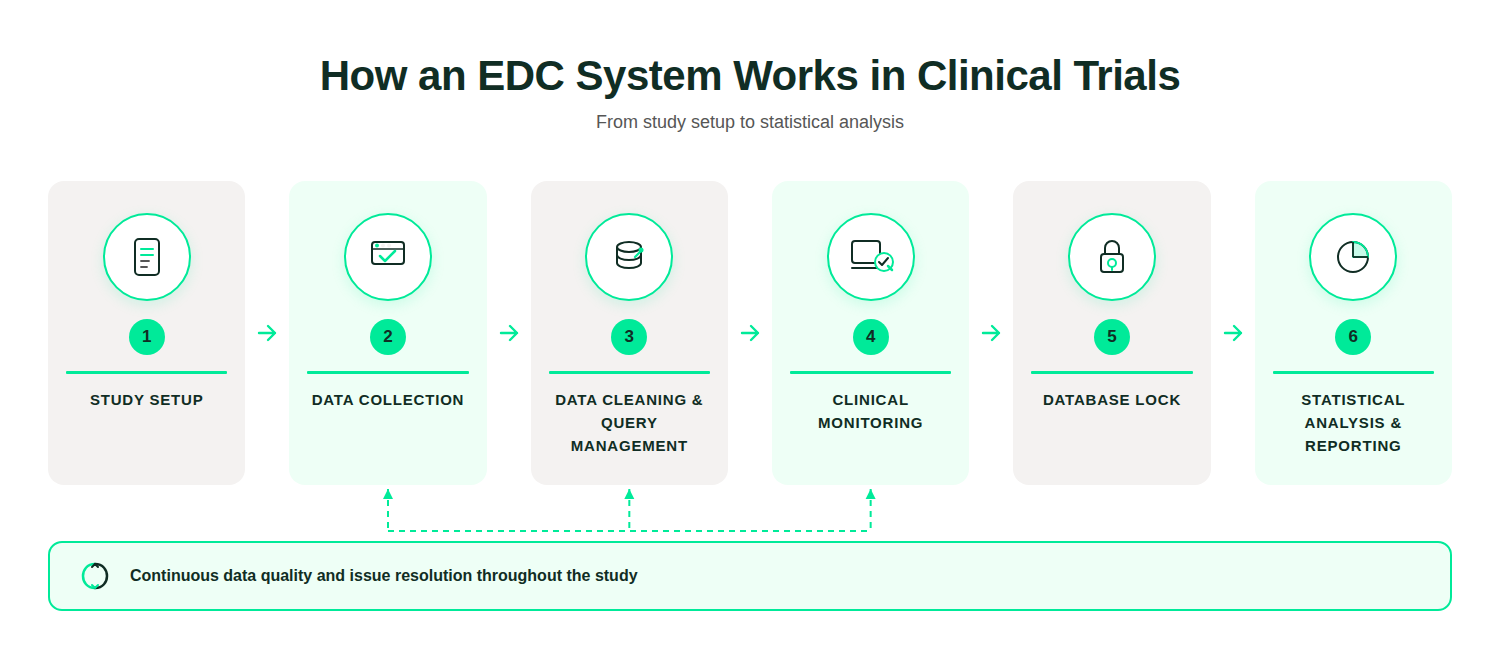
In clinical trials, an EDC system supports the flow of clinical trial data from study setup and data collection through to review, validation, and analysis. The process begins with the protocol, which is used to configure the database, including eCRFs, visits, validation rules, user roles, and study-specific workflows.
Once the study is live, investigators and research teams enter clinical trial data directly into the
eCRF. Depending on the clinical trial, this may include
participant demographics and baseline characteristics, medical history, clinical assessments, vital signs, treatment and concomitant medication data, laboratory and diagnostic results, adverse events and other safety data, and clinical outcome data.
Additional data may also be collected directly from participants through ePRO or integrated from external sources such as laboratories, medical devices, and other clinical systems.
FDA guidance recognizes both manual and electronic capture of source data into eCRFs, as well as data originating from other electronic systems. Every data entry and subsequent change should remain traceable through the
audit trail, allowing the history of the data to be reconstructed from initial entry through subsequent corrections. For FDA-regulated clinical investigations subject to
21 CFR Part 11, the EDC should support the applicable controls for electronic records and electronic signatures.
As data enters into EDC software, predefined validation rules and edit checks can automatically identify missing, inconsistent, or out-of-range values and generate queries for review and resolution. Data cleaning and query management continue throughout the clinical trial as new information is collected and reviewed.
Throughout the study, data managers and monitoring teams can review incoming data, resolve queries, track data quality, and monitor study progress from a centralized environment. Depending on the monitoring strategy, this may also include source data review (SDR) and source data verification (SDV). These activities are typically performed using a risk-based approach rather than as a uniform review of every data point.
At predefined milestones during the clinical trial, investigators review and endorse the data reported under their responsibility. EDC systems can support this process through controlled electronic review and sign-off workflows. The timing and frequency of sign-off should be defined for the trial and should not be limited to a single signature immediately before database lock.
As the clinical trial approaches completion, outstanding queries and data issues are resolved and final data reviews are performed. Once the necessary data management and review activities have been completed, the database can be locked, restricting further modification of the finalized clinical trial data.
The resulting datasets can then be exported for statistical analysis and reporting or, in more advanced EDC platforms, analyzed directly within the same environment.
In practice, an EDC provides a continuous data workflow from protocol to analysis, keeping clinical trial data centralized, controlled, and traceable throughout the study.
What Is the Difference Between a CTMS and an EDC?
A CTMS (Clinical Trial Management System) and an EDC (Electronic Data Capture) system are two complementary tools used in clinical trial management, but they serve distinct purposes.
- A CTMS solution focuses on the operational management of the study. It is used to plan study milestones, track site performance, manage monitoring visits, oversee participant enrollment, track regulatory deadlines, and administrative or financial aspects. It is the primary project management tool for clinical operations teams.
- An EDC software, on the other hand, is purpose-built to
manage study data. It enables teams to
design data collection forms,
capture and
validate clinical data,
consolidate it, and
make it available for analysis and reporting.
What is the difference between an eCRF and an EDC?
Although the terms eCRF and EDC are often used interchangeably, they refer to two distinct components of the clinical research environment.
- An EDC (Electronic Data Capture) is a software platform used to design, collect, centralize, validate, and manage clinical data throughout the study lifecycle. Depending on the solution, it brings together all the capabilities needed to manage the full clinical data lifecycle, from study design and data collection through to reporting and statistical analysis.
- An eCRF (Electronic Case Report Form)
is the electronic form used within an EDC to capture participant data. Investigators use it to enter study data, while monitors and data managers review entries, resolve queries, and oversee data quality.
Who Uses an EDC software in Clinical Research?
An EDC solution is designed for any organization that needs to collect, manage, and analyze clinical study data in a secure environment.
It is commonly used by:
- Medical device manufacturers conducting pre-market clinical investigations and Post-Market Clinical Follow-up (PMCF) studies.
- Contract Research Organizations (CROs) managing clinical studies on behalf of sponsors.
- Hospitals, academic medical centers, and universities conducting clinical research projects, including observational studies and both interventional and non-interventional research.
- Biotechnology companies developing new treatments and therapies.
- Research institutes, learned societies, and public health organizations involved in clinical research.
- Pharmaceutical companies running clinical trials.
Within these organizations, EDC software is used daily by investigators, clinical research coordinators, clinical research associates (CRAs), data managers, biostatisticians, project managers, and sponsors,
all collaborating throughout the study within a single platform.
What Is the Role of an EDC?
The purpose of an EDC system is to centralize the collection and management of clinical data throughout the study. Investigators, monitors, data managers, biostatisticians, and sponsors can all work from the same dataset, from initial data entry through to reporting and statistical analysis.
By bringing all data together within a single platform, an EDC reduces reliance on disconnected tools and makes it easier for every team involved in the trial to manage and leverage study data.
As clinical research continues to evolve, modern EDC platforms now go well beyond data collection. They can support additional clinical data management processes and connect with external systems
through API integrations. More advanced solutions, such as
EasyMedStat, go a step further by incorporating
built-in statistical analysis capabilities.
What Are the Key Features of an EDC System?
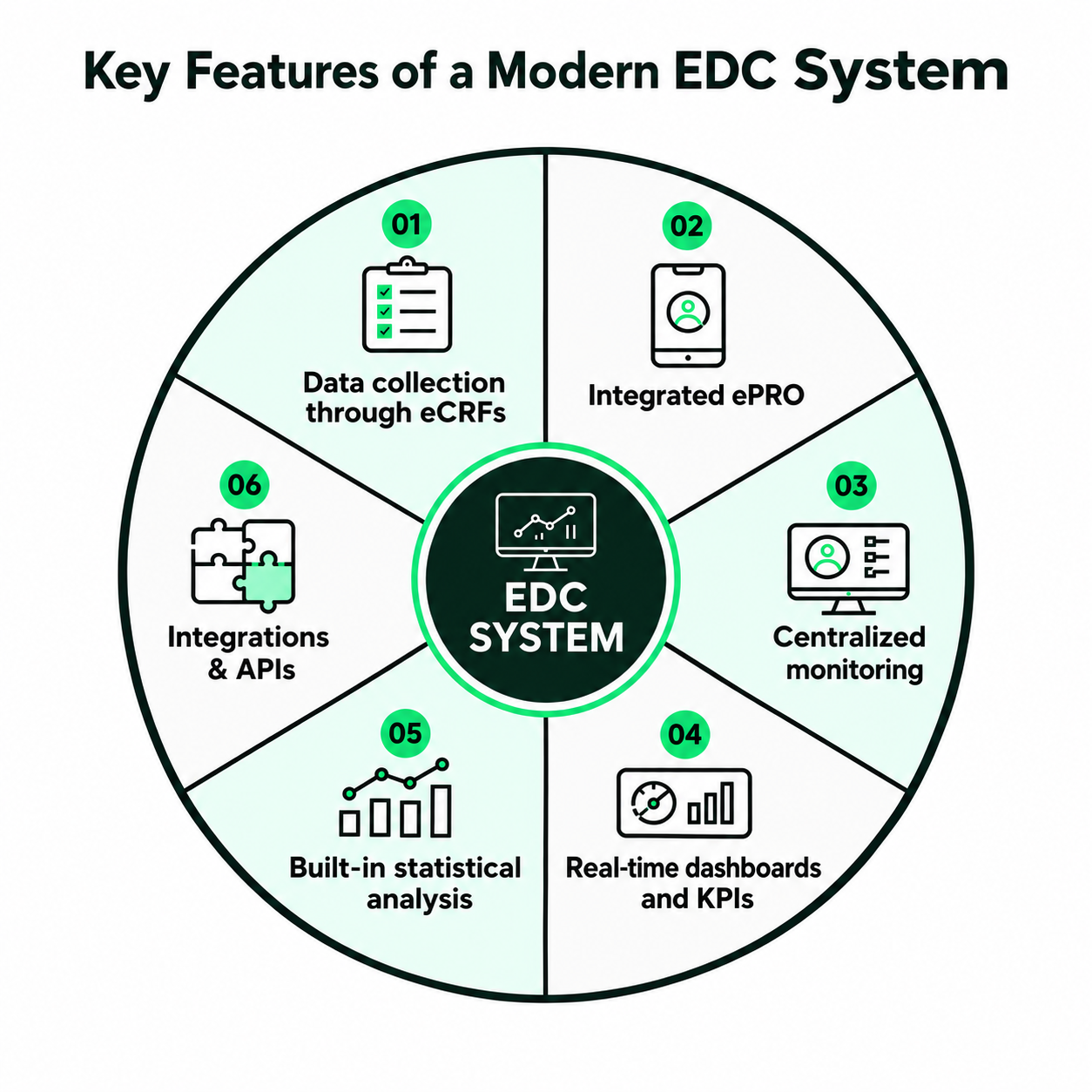
Data collection through eCRF: EDC software enables research teams to design and deploy eCRFs (electronic case report forms) used to collect study data. Structured around the study protocol and visit schedule, these forms serve as the primary interface for investigators and research teams to enter clinical study data.
Centralized monitoring: A modern EDC solution gives monitoring teams a
centralized view of study data and its validation status. Clinical Research Associates (CRAs) can identify data to be reviewed, track open queries, document source data verification, and oversee site progress, all from within the platform.
Integrated ePRO: Electronic Patient-Reported Outcomes
(ePRO) allow patients to complete questionnaires directly
from a smartphone, tablet, or computer.
Responses are automatically integrated into the database,
with no manual re-entry required.
Real-time dashboards and KPIs: Built-in dashboards provide
live visibility into enrollment, site performance, missing data, and data quality indicators,
enabling more effective oversight of clinical trials at every stage.
Built-in statistical analysis: Some advanced EDC solutions, such as
EasyMedStat, go beyond data collection and management by integrating statistical analysis tools directly into the platform. Research teams can analyze collected data within the same environment,
without having to export data to separate statistical software.
What Are the Regulatory Requirements for an EDC System?
An EDC tool used in clinical research must meet strict requirements around data integrity, traceability, and security, applicable across the entire data lifecycle, from collection to storage and analysis.
To meet these standards,
EDC platforms incorporate mechanisms for access control, change tracking, and data protection. A complete
audit trail, role-based permissions, electronic signatures, and data security protocols are all essential components of a
compliant EDC environment.
The applicable regulatory framework depends on the nature of the study and the countries in which it is conducted. EDC systems may be subject to
ICH Good Clinical Practice (GCP) guidelines, the EU Clinical Trials Regulation,
ISO 14155 for medical device clinical investigations, or
FDA 21 CFR Part 11 in the United States.
In Europe, the processing of personal data must also comply with GDPR, and in France, with
CNIL requirements and
health data hosting (HDS) standards.
One platform to manage your clinical trials.
Book a call with our team and see how fast you can build and launch your first study with
EasyMedStat.
What Are the Key Benefits of EDC Software?
Beyond operational efficiency, the shift to an EDC fundamentally changes how clinical teams interact with study data and with each other.
A single source of truth: An EDC centralizes clinical trial data and makes it available to research teams as soon as it is collected. Unlike processes relying on multiple tools or disconnected files, all stakeholders work from the same, continuously updated dataset throughout the trial.
Faster access to data: Data entered by sites is available in the system immediately, allowing authorized teams to
monitor study progress and access the information they need in real time,
without waiting for manual consolidation.
Higher data quality: Built-in validation checks help quickly identify missing, inconsistent, or incorrect data. Monitoring workflows and query management
facilitate ongoing review and correction throughout the clinical trial, resulting in
cleaner, more complete data at database lock.
More efficient study management: By bringing data collection, review, and management into a single environment, an EDC solution improves collaboration between
investigators,
CRAs,
data managers, and
sponsors, while significantly
reducing the manual workload associated with data management.
Stronger security and traceability: Access controls, audit trails, and data protection mechanisms ensure that every action taken in the system is tracked, and that only authorized users can view or modify clinical trial data.
How to Choose the Right EDC Software for Clinical Trials?
There are many EDC solutions on the market today, but not all offer the same level of flexibility and user autonomy. Beyond features and regulatory compliance, the right choice also depends on the platform's ability to adapt to the specific needs of each clinical trial and the teams running it.
A flexible, configurable platform:
A modern EDC tool should allow teams to design and evolve clinical trials without depending on custom development for every change. Form creation, validation rules, and workflow configuration should all be manageable directly within the platform, ideally in a
no-code environment.
An intuitive user experience: An
EDC software is used daily by a wide range of profiles:
investigators,
CRAs,
data managers, and
sponsors. A
clean,
modern, and
easy-to-navigate interface drives adoption and minimizes onboarding time across teams.
Integration capabilities: A modern
EDC software solution must connect with the other systems used in the study. Through
API
integrations, the platform can automatically pull data from external sources and consolidate it within the study environment,
reducing manual re-entry. This becomes increasingly important as clinical data sources continue to multiply.
Fast deployment: The time required to move from protocol to a fully operational trial is a key selection criterion. A platform that is
easy to configure, combined with
efficient onboarding and
validation processes, shortens time to go-live and accelerates the start of data collection.
A solution that scales with your clinical trials: Choosing an
EDC tool should not only address the immediate needs of a single project. The platform must be able to adapt to different study types, as well as
varying data volumes and
levels of complexity, today and
as your research program grows.


Share this article